
A Picture Is Worth 1,000 Words. This Graph Reveals an 8 Billion Dollar Patent Decision Problem
Rethinking the Maintenance Fee and Annuity Renewal Decision Process
At first glance, nothing about this graphical image looks unusual.
Patents get issued.
A small percentage are licensed or commercialized through companies.
Some are abandoned.
Most are quietly maintained.
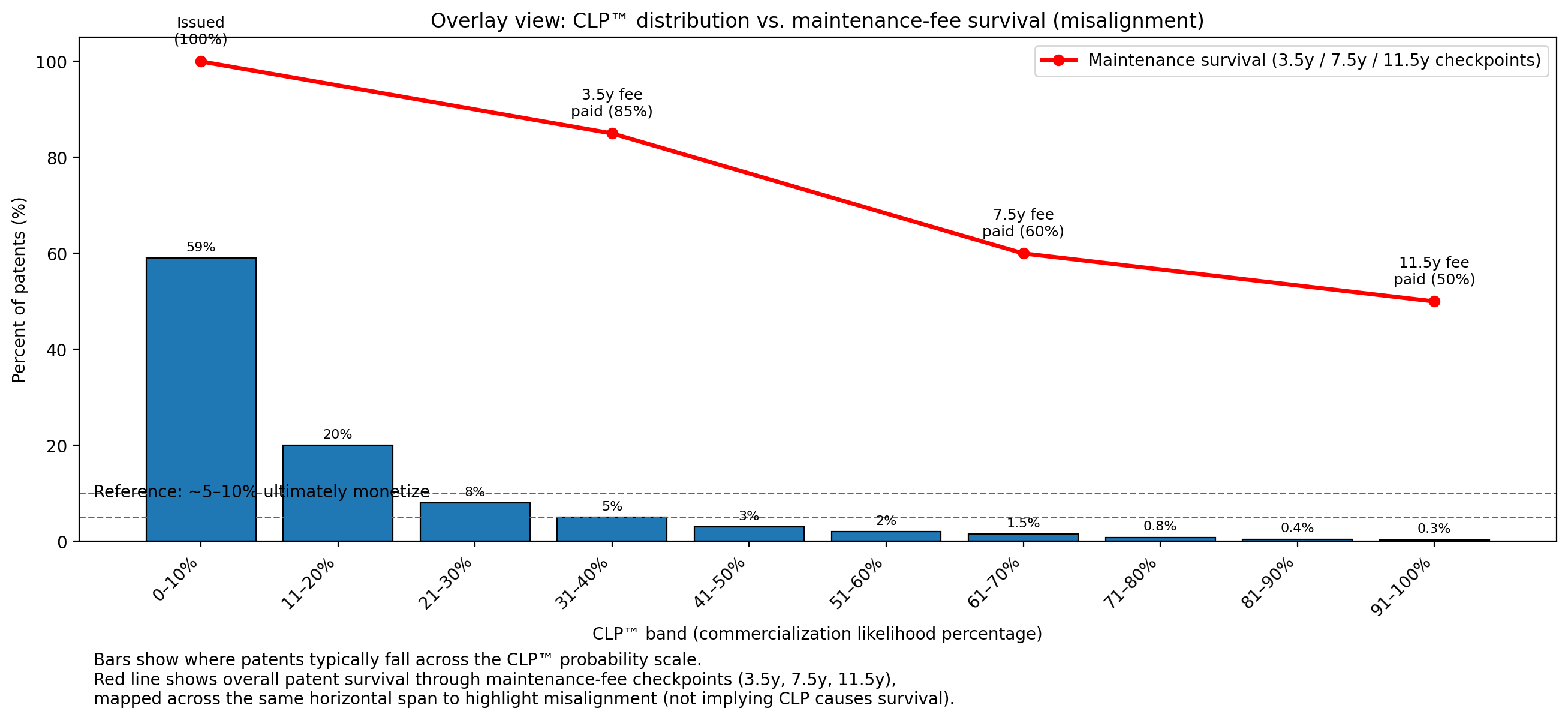
The truth is patent owners spend billions of dollars each year on maintenance and renewal fees, often without the same rigor they apply to other investment decisions. However, when you put two signals side-by-side, commercialization likelihood percentage and maintenance‑fee survival behavior, an uncomfortable question comes into focus: are patent maintenance decisions being made with evidence, or by habit?
Two signals. One clear disconnect.
One side of the chart shows the Commercialization Likelihood Percentage, or CLP. CLP is a probabilistic metric designed to estimate how likely a patent is to be successfully commercialized, licensed, or monetized, based on historical outcomes, academic research, and observed market and technology characteristics.
The takeaway is straightforward and sobering. Only a small fraction of patents, on the order of about 5 percent, have a greater than 50 percent chance of commercialization.
Now look at the other side of the picture: maintenance fee survival behavior.
Historically:
~85% pay the first fee
~60–70% the second
~45–50% the third.
One signal reflects likelihood. The other reflects belief and behavior.
The widening gap between the two is where waste hides in plain sight.
Let’s be clear. Paying maintenance fees is often rational.
Before going any further, this needs to be stated plainly.
Paying patent maintenance fees is not inherently wrong. In many cases, it is entirely rational.
There are well established reasons patents are maintained across their full term.
Defensive and strategic holdings.
Large organizations often maintain patents to preserve freedom to operate, strengthen negotiating leverage, support cross licensing strategies, or deter litigation. These patents may never be licensed directly, and that can still be a sound strategic decision.
Long-horizon or ahead of their time technologies
Some inventions are simply early. They may not align with market readiness until standards mature, infrastructure develops, or complementary technologies catch up. In those cases, meaningful commercialization may not occur until after the second maintenance window, or even later.
Portfolio and signaling effects
Certain patents derive value as part of a broader family or strategic portfolio, even if their standalone commercial prospects appear modest.
None of this is disputed.
The issue is not maintenance. The issue is missing due diligence.
The real issue is how maintenance decisions are made.
Even after accounting for defensive, strategic, and long horizon patents, those categories represent a minority of overall maintenance fee exposure, particularly for universities, startups, federal laboratories, and individual inventors.
In many organizations, maintenance fees function as a default administrative step, a legacy habit, or a just in case decision, rather than adeliberate investment choice supported by evidence.
This is not a failure of intent. It is a failure of specifically purposed data and process.
A lived example from inside technology transfer
This disconnect is not theoretical.
In 2007, I made a career transition from being a senior scientist in the biotech industry into my first technology transfer role, supporting a U.S. Army laboratory as a contractor. Within my first year, a patent attorney sent me a list of roughly 25 to 30 patents with a simple request.
Which ones should we pay maintenance fees on, and which ones should we let go?
I had about two weeks to decide.
What surprised me was not the responsibility. It was that there was no industry wide objective data source or methodology I could call upon to make those decisions in a consistent, defensible way.
The guidance was limited. If a patent was licensed, we paid it. If there was active licensing interest, we paid it. Otherwise, we made a few outreach calls to potential licensees and used judgment.
In later roles, including similar exercises at NASA and in other organizations, the same pattern repeated. A few times a year, the same decisions were made under time pressure, largely driven by experience and instinct.
Eventually, as a patent owner myself, I faced the same decision at my own maintenance window.
This is a structural problem, and it is one that many technology transfer professionals and patent owners immediately recognize.
Introducing maintenance fee due diligence.
The right question is not, “Should we pay this maintenance fee?”
The better question is, “What do we know today that justifies paying it?”
Maintenance fees should be treated as decision checkpoints, not automatic renewals.
At a minimum, Maintenance Fee Due Diligence should include the following.
A current positioning reality check
Markets change. Competing alternatives emerge. Adoption barriers persist.
Every patent deserves a fresh look at how it compares to today’ssolutions, why adoption has or has not occurred, and where differentiationstill exists. This does not need to be expensive. It needs to be current.
Real market feedback
Primary outreach to knowledgeable industry participants, particularly potential licensees, provides unfiltered signal.
When done correctly, this serves two purposes. It produces evidence-basedfeedback, and it naturally surfaces licensing interest if real value exists.
Data over bias
Absent data, human psychology fills the gap. Sunk cost bias, optimism bias, fear of missing out (FOMO), and status quo bias all play a role.
Data does not replace judgment, but it anchors it.
Where CLP fits
This is where Commercialization Likelihood Percentage becomes useful.
CLP provides probabilistic context grounded in historical outcomes and market relevant signals. It does not declare winners or losers. It answers a simpler and more honest question.
Given what we know from history and market behavior, how likely is this patent to succeed?
Used correctly, CLP supports expert decision making rather than replacing it.
Scale matters. Here is what the fee system alone tells us.
To keep the economics clean, it helps to separate USPTP total patent fee revenue for maintenance fee collections.
USPTO maintenance fee collections
USPTO public financial reporting indicates that patent fee revenue is on the order of $3.6–$4.0 billion annually. A Federal Register notice states that maintenance fees accounted for 54.9% of patent revenue in FY2023. Together, these data points suggest USPTO maintenance fee collections are likely in the range of $2 billion per year, although the agency does not publish a single consolidated maintenance-fee total.
Those two facts imply that USPTO maintenance fee collections are on the order of about $2 billion per year.
Global renewals
A widely cited analysis estimates around $8 billion per year is spent on patent renewals at the top 10 patent offices worldwide. (IPWatchdog)
These figures aren’t directly comparable: one is one office’s collections (USPTO), while the other is an estimated multi-office total that includes the USPTO plus other major global offices.
A conservative economic signal for universities and federal portfolios
Now bring it back to day to day decision making.
Using small entity USPTO maintenance fees, which commonly apply to universities and many federal institutions, a basic maintenance fee due diligence approach can free up on the order of seven thousand dollars perten patents in expected U.S. maintenance fee exposure over the remaininglife of the portfolio.
A few clarifications matter.
This figure reflects modeled exposure, not a single year cash savings. It covers U.S. maintenance fees only. It does not include foreign annuities, which often represent a larger cumulative cost for global patent families.
In other words, the U.S. number is a floor, not the full picture.
Why this matters now
Budgets are tightening. Oversight is increasing. IP portfolios are being asked, rightly, to justify their costs.
Maintenance Fee Due Diligence does not start with a goal of cutting patents. It starts with a goal of making each renewal decision defensible. In practice, that discipline often reallocates spend away from automatic renewals and toward value creation, including targeted outreach, market feedback, and licensing conversations as maintenance windows approach. The result is a portfolio that is easier to defend, more intentionally managed, and more likely to generate transactions rather than carry cost by default.
Final perspective
I have spent more than 26 years as an inventor and a technology transfer and commercialization professional. My experience spans the U.S. Army, NASA, and other organizations, plus years of consulting to startups, universities, and companies.
Over my career, I have assessed and evaluated more than 1,500 inventions and patent assets. I have negotiated and supported licensing transactions, advised on portfolio strategy, and helped teams make hard decisions about which technologies to advance, which to hold, and which to let go.
What has changed is not the need for judgment. What has changed is that we can now support judgment with data, market signal, and probability.
Patent maintenance decisions should not be driven by habit or hope alone. Today, they do not have to be.
The question every patent owner should ask as a maintenance window approaches is simple.
If we were making this decision today, knowing what we know now, would we make it the same way?
That question changes outcomes.
To learn more about Commercialization Likelihood Percentage, visit: https://www.patentelligence.ai/navabr/methodology/commercialization-likelihood-percentage