
CLP and its Power Explained
The Missing Layer Behind Cost-Intelligent Patent Renewals, Global Filings, and Invention Disclosure Triage
A lot of people saw the maintenance-fee post and asked the same question in different ways: What is Commercialization Likelihood Percentage (CLP), really? And equally important, what is it not?
That question makes sense because patent decisions are one of the few places where organizations routinely spend real money, year after year, while operating with incomplete information. Across major patent offices, renewals alone have been estimated in the billions annually, and the totals get staggering when you look across the full lifetime of all active patents.
Per 10 patents, CLP-driven renewal decisions for US renewal alone can unlock meaningful savings: up to about $24K in net lifecycle savings for small entities when decisions are made at the 7.5-year milestone, and up to about $55K in net lifecycle savings for large entities under illustrative scenarios. In the United States, maintenance fees come due at 3.5, 7.5, and 11.5 years after issue, with escalating cost as the patent ages. Those checkpoints force the same uncomfortable question: Are we paying to protect an asset that will matter, or paying because it feels safer than letting go?
This post is a follow-on to that conversation. The goal is to explain CLP in a way people can understand, trust, and apply to three common decision moments: maintenance and annuity renewals, global filings, and invention disclosure disposition.
In this version, we cover what CLP is, what it is not, and how and where it is used to save budget and increase licensing potential. In the next post, we will go deeper into how CLP bands are interpreted in practice, where go and no-go decision thresholds typically sit, and how CLP connects to the broader Patentelligence 360 workflow, including how subsets of the 29-factor system support market valuation and licensing royalty valuation.
Why CLP matters: three expensive decisions usually made without a calibrated measuring stick
Maintenance and renewals
Renewal decisions are frequently driven by habit, fear of missing a future win, or the lack of a clear commercialization plan. The result is default renewals and compounding cost.
Global and jurisdictional filings
Country-by-country filing and maintenance decisions can become a patchwork of legacy habits. Organizations file where they always file, maintain where they have always maintained, and struggle to tie spend to real commercial leverage.
Invention disclosure triage and filing decisions
Universities and R&D organizations often face large volumes of invention disclosures. Without a fast, consistent way to assess commercialization feasibility early, teams lose time and budget filing inventions that never had a clear commercialization pathway.
CLP was built to address these realities. It gives the expert more structure, more signal, and a consistent way to compare decisions that are otherwise hard to compare.
What CLP is
Commercialization Likelihood Percentage (CLP) is a 0–100 likelihood indicator designed to support expert decision-making by translating commercialization signals into a standardized measure.
Think of it as a ruler or measuring device, not a crystal ball. CLP does not replace expert judgment. It helps experts make better calls faster and more confidently by organizing the right signals into a consistent output.
CLP is designed to answer: How likely is this patent (or invention) to produce commercialization outcomes such as licensing, productization, or monetization leverage?
What CLP is not
• Not a guarantee of revenue or licensing
• Not a legal opinion on enforceability, infringement, or freedom to operate
• Not a replacement for diligence, claim charting, or business execution
• Not a dollar valuation by itself. CLP complements valuation and strategy work, but it is focused on likelihood, not deal size
CLP methodology at a high level
Commercialization outcomes rarely hinge on a single variable. They happen when several conditions are true at the same time.
CLP reflects that by evaluating commercialization signals that align with how experienced technology managers and IP owners assess real-world feasibility. Examples include:
• Market alignment and demand indicators: Is there a clearly defined buyer, a real pain point, and a reachable market?
• Adoption feasibility: Is the timing right, and is the target industry positioned to adopt this type of solution?
• Competitive and evidence signals: Are there patterns that suggest commercial relevance and industry activity around adjacent solutions?
• Monetization pathway plausibility: Are there plausible routes to licensing or commercialization in this category?
• Practical IP posture: Does the asset have a plausible route to enforceable leverage in the intended commercial context?
• Problem-solution fit: Does the invention solve a meaningful problem in a way the market can adopt?
This is enough to understand what CLP is measuring without turning this post into a list of weights, thresholds, or implementation details.
How a percentage becomes useful: CLP as a decision-support measure
A percentage matters only if it helps someone make a better decision.
CLP is designed to give the technology manager, licensing executive, or IP owner a clearer way to measure commercialization likelihood across a portfolio. It supports decisions that otherwise become subjective debates.
Two practical points matter:
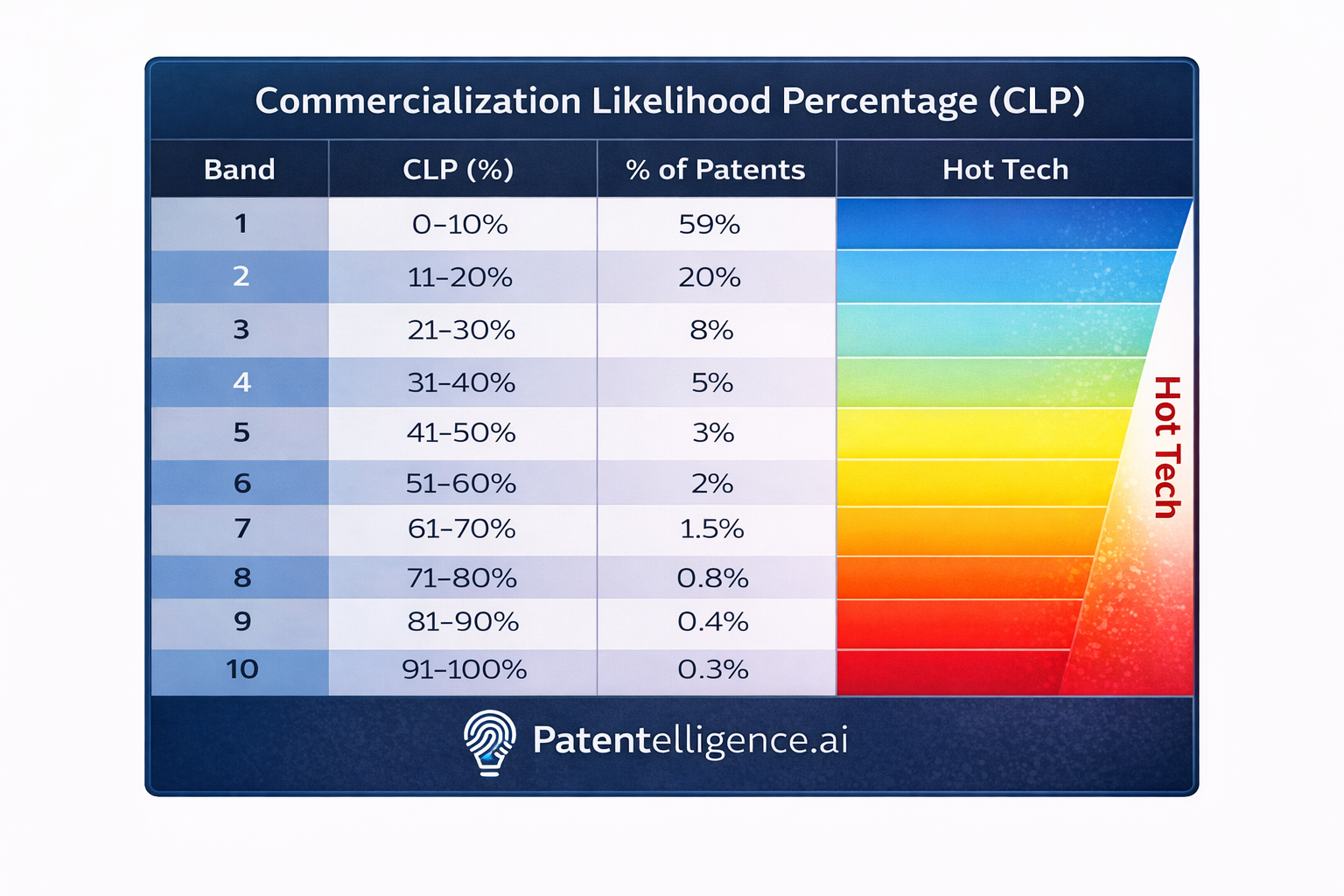
• CLP is best interpreted in bands because the goal is decision clarity, not false precision.
• Truly high likelihood outcomes should be uncommon. Commercial success is not evenly distributed across patents, and the scoring distribution should reflect that reality.
Where CLP is used: four applications that drive the most value
This post focuses on the core uses where CLP consistently saves time, reduces waste, and improves decision discipline.
1) Maintenance fee decision support
Maintenance fee decisions are often made without a consistent method to connect spend to commercialization likelihood. CLP changes that by helping teams prioritize patents that merit continued investment and by prompting an action plan for monetization.
Applying CLP at the 7.5- and 11.5-year milestones is especially impactful because those are common default renewal points and the fees are substantial.
Practical savings examples (U.S. maintenance fees only)
Below are examples from conservative renewal-diligence scenarios. Figures are net of Patentelligence service fees and reflect U.S. maintenance fees only, with additional upside possible when foreign annuities, prosecution tail, and opportunity-cost reallocation are included.
Small entity, per 10 patents (illustrative scenario: 10 triaged; 5 escalated; 4 maintained; 6 retired)
• $13,875 net savings per 10 patents at the 11.5-year decision point (immediate-year)
• $3,699 net savings per 10 patents at the 7.5-year decision point (immediate-year)
• $23,571 net lifecycle savings per 10 patents when decisions are made at 7.5 years (avoids 7.5 plus downstream 11.5 on retired assets; multi-year avoided spend)
Large entity, per 10 patents (illustrative scenario: 10 triaged; 6 escalated; 5 maintained; 5 retired)
• $34,803.60 net savings per 10 patents at the 11.5-year decision point (immediate-year)
• $13,603.60 net savings per 10 patents at the 7.5-year decision point (immediate-year)
• $55,003.60 net lifecycle savings per 10 patents when decisions are made at 7.5 years (avoids 7.5 plus downstream 11.5 on retired assets; multi-year avoided spend)
• $65,753.60 net lifecycle savings per 10 patents when decisions are made at 3.5 years (avoids 3.5 plus 7.5 plus 11.5 on retired assets; multi-year avoided spend)
These examples should be interpreted as decision-support illustrations, not promises. Actual savings depend on portfolio mix, entity status, and decision thresholds.
2) Global and jurisdictional filing decisions
Most organizations agree that global filing strategy should be tied to commercial reality. Many struggle to do it consistently.
CLP can be applied at the jurisdiction level to support two high-stakes decisions:
• Where to file next (PCT to national phase decisions)
• Where to maintain (country-by-country renewal and annuity decisions)
Jurisdictional decision-making works best when commercialization likelihood is paired with regional relevance factors such as:
• where customers and revenue are concentrated
• where competitors manufacture, sell, or distribute
• how enforcement leverage translates into commercial leverage in that country
• prosecution, translation, and maintenance costs over time
This is how CLP helps organizations focus spending at the level of the winner, not just which patents to keep, but which patents to keep in which countries.
3) Invention disclosure triage and filing decisions
One of the highest-volume decision funnels is not renewals. It is invention disclosures.
For universities and large R&D organizations, the pain is straightforward: high disclosure volume, limited budgets, limited staff time, and high variability in commercialization readiness.
CLP-style analysis applied to invention disclosures supports:
• faster screening for commercialization feasibility
• clearer prioritization for filing spend
• earlier identification of plausible licensing pathways and target industries
• fewer filings that never had a credible commercialization plan
This is not about rejecting good science. It is about matching filing decisions to realistic commercialization opportunity and building clearer market narratives earlier.
4) Portfolio triage and licensing prioritization
CLP is also used for portfolio-level triage, which is where the time savings compound.
Instead of treating every patent as equally deserving of attention, CLP supports:
• prioritizing which assets warrant deeper diligence
• focusing licensing outreach on the most promising assets first
• improving internal alignment across technology, legal, and finance stakeholders
Used well, portfolio triage becomes less about pruning and more about increasing the odds that the right patents receive the right level of effort.
A simple way to use CLP in real decisions
CLP works best when it is used as part of a consistent workflow:
1) Start with the decision moment: renewal, jurisdictional filing, global maintenance, or invention disclosure triage
2) Gather the information needed for an accurate assessment: technology, market context, maturity, and intended use
3) Use CLP bands to prioritize which items justify deeper diligence and which do not
4) Pair the score with an action plan: market outreach, evidence gathering, licensing targets, jurisdiction strategy, or a rationalized sunset decision
5) Document the rationale so decisions remain consistent over time
CLP should function as a trigger to diligence and action. Part of that diligence is exposing the patent and its potential value to knowledgeable industry experts who can provide primary feedback on how the technology stacks up against the state of the art and real market needs. Where commercialization merit still exists, that exposure often leads to licensing conversations. Where it does not, the combination of evidence and CLP positioning supports a confident, defensible cost-saving decision.
Top 5 CLP questions
What does CLP measure, in one sentence?
CLP is a likelihood indicator designed to estimate how likely a patent or invention is to produce commercialization outcomes such as licensing, productization, or monetization leverage.
Is CLP a guarantee?
No. CLP is decision support. It helps prioritize decisions and actions under uncertainty.
How should I interpret CLP in practice?
CLP is best interpreted in bands. The purpose is to prioritize action, not to promise a result. High likelihood outcomes should be uncommon.
Can CLP be applied internationally, by country?
Yes. CLP can support jurisdiction-by-jurisdiction filing and maintenance decisions when combined with regional fit factors such as market presence, competitor footprint, enforceability leverage, and cost.
Can CLP be used before a patent is filed?
Yes. CLP-style analysis can be used at the invention disclosure stage to support filing decisions by assessing feasibility, market alignment, and plausible monetization pathways before prosecution costs compound.
What comes next
In the next post, we will go deeper into how CLP bands are interpreted in practice, where go and no-go thresholds typically sit for different decision types, and how CLP connects to the Patentelligence 360 workflow, including how subsets of the 29-factor system support market valuation and licensing royalty valuation.
Let us Show You
If you are managing renewals, planning global filing strategy, triaging a portfolio, or evaluating invention disclosures before filing, we can show you how CLP fits into your workflow and where it creates the most leverage.
Learn more or contact us here: support@patentelligence.ai