Why Responsible AI Isn’t Optional in IP Valuation
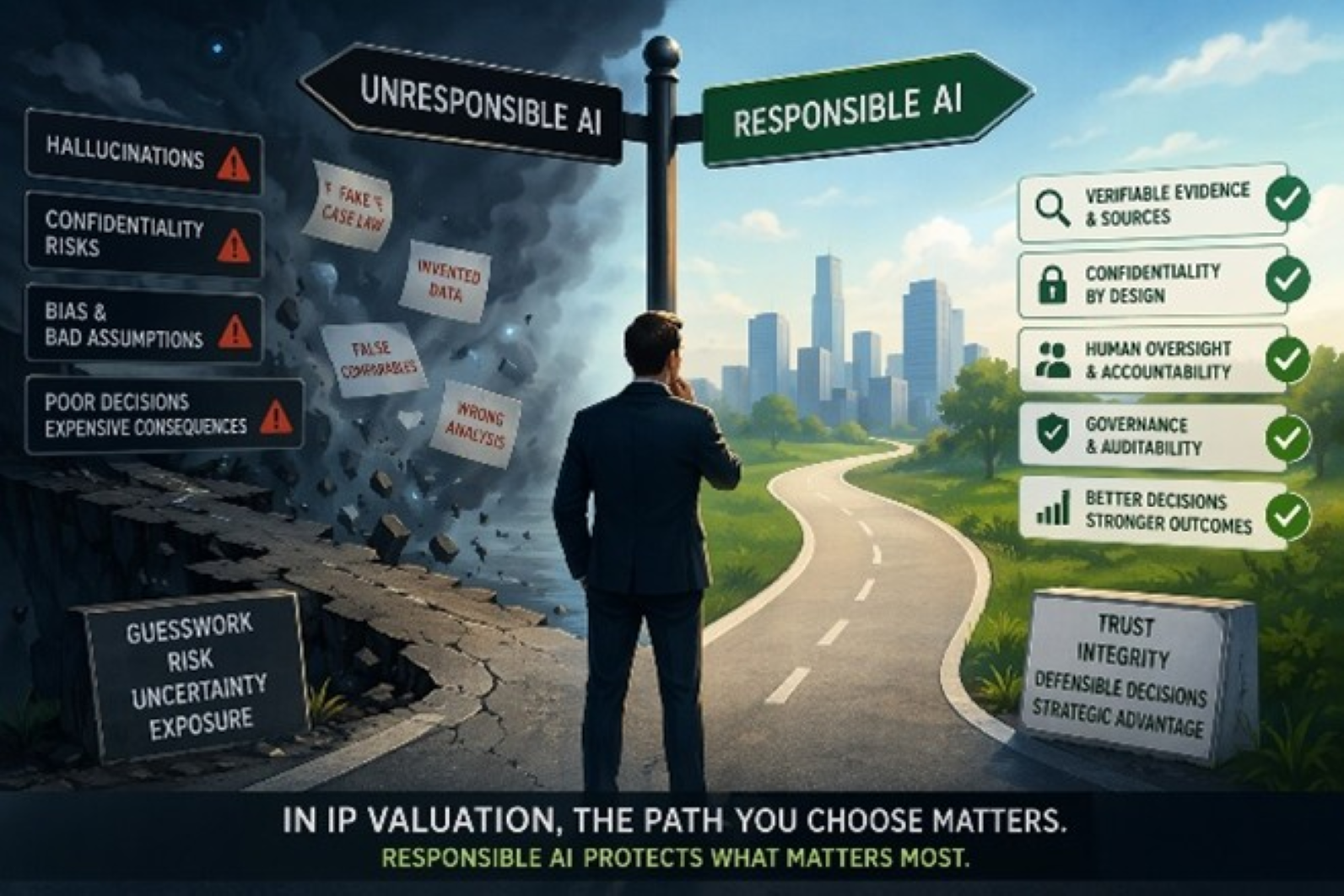
You cannot build workflows on AI systems that hallucinate. It won’t scale, and most will fail.
Two Fortune Magazine articles published in mid-to-late 2025 highlight the problem and the high stakes of hallucination-driven errors.
In the first, Fortune reports: “MIT report: 95% of generative AI pilots at companies are failing”
The second has the following title, which speaks for itself: “Deloitte was caught using AI in $290,000 report to help the Australian government crackdown on welfare after a researcher flagged hallucinations”
The patent commercialization ecosystem punishes guesswork and errant decisions.
Patent commercialization is inherently difficult, and the odds are not friendly. In patent commercialization, small errors have permanent and costly consequences. A single word in a claim can determine enforceability. A misread prosecution history can collapse a licensing position. A weak assumption about market demand can distort a maintenance fee decision. A fabricated comparable can anchor a negotiation in the wrong universe.
AI can help IP experts move faster and cover more ground. But in this ecosystem, AI also introduces new failure modes that you cannot afford to ignore.
Responsible AI is not a bonus. It is a requirement and must be the standard.
The first deal breaker: hallucinations
Hallucinations are not a minor bug. In IP valuation, they are a catastrophic risk. When an AI system fills gaps with plausible-sounding fiction, the output looks credible. It reads clean. It sounds confident. It can even look more polished than a human draft.
But if it invents any of the following, your decision foundation breaks:
• A comparable licensing deal that never happened
• A royalty rate that is not tied to a source
• A market size number with no defensible basis
• A product adoption claim that cannot be verified
• A “fact” about a patent family, owner, or legal status that is wrong
In a pitch deck, a licensing outreach campaign, or a go/no-go decision on maintenance fees, annuities, or jurisdictional filings, those errors do not stay contained. They propagate and have costly consequences.
The second deal breaker: confidentiality
IP strategy is competition sensitive.
Patent portfolios, licensing targets, negotiation positions, and non-public commercialization signals are not casual inputs. They are sensitive assets and business-sensitive information. When people paste claims, strategy, or draft claim charts into generic AI tools, a critical question often goes unasked:
Where does this data go, who can access it, and what controls exist to prevent leakage?
Responsible AI in IP requires a security posture that respects the reality of the domain. Confidentiality is not a compliance checkbox. It is a competitive necessity.
The hidden risk nobody budgets for: bias stacking
AI risk is not only about system performance. It is also about how people interpret and trust the output.
These biases often stack, meaning one bias makes the next more likely, especially when outputs are fast, confident, and neatly formatted.
Automation bias plus authority bias
If an output looks machine generated, people assume it is objective. If it is labeled as AI, it can also feel more authoritative than it deserves. That combination makes teams less likely to challenge assumptions, even when something feels off.
Anchoring bias plus false precision
A single number, even a wrong one, becomes the anchor.
If an AI suggests a valuation, royalty rate, or market size, the next discussion often revolves around adjusting it slightly instead of questioning whether it is valid in the first place.
Confirmation bias plus selective sourcing
Teams naturally prefer evidence that supports the story they already want to be true. If the AI retrieves sources that align with the preferred narrative, and the workflow does not force contradictory evidence checks, the system becomes a justification machine instead of an analysis engine.
Availability bias plus recency bias
The most visible examples and the most recent headlines feel more representative than they are. Without source hierarchy and calibration, AI can overweight what is easy to find instead of what is most economically relevant.
Bias stacking is why “good outputs most of the time” is not a safe standard.
Responsible AI must be designed to slow down the exact moments when people are most likely to accept a bad answer.
What “Responsible AI” means in IP valuation
Responsible AI is not a slogan. It is a governed workflow.
A responsible system is designed to reduce hallucinations, protect confidentiality, and keep accountability with the human expert.
In practice, that means you need controls like these:
Evidence first, always
Claims about markets, adoption, and deals must be tied to verifiable sources.
If the system cannot support a claim, it must say so clearly. Opinions must be separated from evidence.
Source hierarchy and auditability
The workflow must record what sources were used and where each key conclusion came from.
Outputs should be easy to defend and easy to challenge.
The goal is not only speed. The goal is traceable reasoning.
Uncertainty signaling
Not everything can be known from public sources.
A responsible system flags uncertainty and lists assumptions explicitly.
It avoids pretending uncertainty does not exist.
Human accountability
IP experts remain responsible for the final decision.
The system supports, drafts, and accelerates, but it does not replace judgment.
There must be explicit review gates before outputs are treated as decision-grade.
Confidentiality by design
Sensitive inputs must be handled with controlled access, clear policies, and appropriate safeguards.
If a workflow cannot answer the confidentiality question, it is not ready for serious IP work.
Where Patentelligence’s Patent Artificial Intelligence Valuation Engine (PAIVE™) fits
PAIVE™ is our governed, agentic AI system designed for patent valuation and patent commercialization support.
It exists because generic AI tools are not built for this ecosystem.
Patent commercialization demands disciplined evidence handling, defensible outputs, and human accountability. It also demands that confidentiality and governance are treated as first-order requirements.
PAIVE™ is built to provide defensible decision support for IP experts with faster diligence, lower cost, and more consistent analysis, while respecting the constraints that matter in real transactions.
What PAIVE™ will not do
Trust requires boundaries.
Here are ours. PAIVE™ does not:
- Present outputs as legal advice.
- Promise outcomes. Patent value and commercialization are probabilistic by nature.
- Treat AI output as self-justifying. If it cannot be defended, it does not belong in the report.
- Use false precision. Ranges and bands exist for a reason.
- Treat confidentiality like an afterthought.
The expert stays accountable for conclusions and strategy.
A quick test for any AI used in IP valuation
If you are evaluating an AI tool for patent commercialization work, ask these questions:
- Can it show exactly where key claims came from, including sources and assumptions?
- Does it distinguish evidence from inference?
- Does it flag uncertainty and contradictions instead of hiding them?
- What confidentiality controls exist, and can they be explained in plain language?
- What human review gates exist before outputs are treated as decision-grade?
- Does the system reduce bias stacking, or does it accelerate it?
If those questions cannot be answered clearly, the tool is not ready for serious IP decisions.
Final perspective
The patent commercialization ecosystem rewards disciplined decision-making and punishes guesswork.
AI can be a force multiplier for IP experts, but only if it is governed, auditable, and designed for this domain.
Responsible AI is not optional.
It is how you protect trust, protect confidentiality, and protect the integrity of the decisions you make with your patents.
Contact us
If you would like to learn more about our responsible, agentic AI built for patent valuation and IP commercialization strategy development, contact us at support@patentelligence.ai.