
CLP Bands & Go/No-Go Zones Explained: How to Read a Commercialization Likelihood Signal With Confidence
.png)
A commercialization signal should support the IP expert’s decision, not make it
It has been several months since we last wrote about Commercialization Likelihood Percentage™ (CLP) and our Patentelligence™ Artificial Intelligence eValuation Engine (PAIVE™). During that time, we have been listening.
We have been conducting discovery conversations with technology transfer offices, corporate intellectual property teams, and portfolio stewards responsible for managing dozens and even hundreds of assets. Those conversations have shaped how we explain CLP bands, commercialization readiness, and the role of evidence-based decision support.
This article reflects that evolution.
The central point is simple: CLP and PAIVE™ are not designed to replace institutional judgment. They are designed to strengthen it by making IP asset decisions more informed, consistent, scalable across high-throughput portfolios, and defensible when those decisions are later reviewed or challenged.
Defensibility is the point
Patent commercialization is inherently difficult, and the odds are not friendly. In patent commercialization, small errors have permanent and costly consequences. A single word in a claim can determine enforceability. A misread prosecution history can collapse a licensing position. A weak assumption about market demand can distort a maintenance fee decision. A fabricated comparable can anchor a negotiation in the wrong universe.
AI can help IP experts move faster and cover more ground. But in this ecosystem, AI also introduces new failure modes that you cannot afford to ignore.
Portfolio size and scalability matter
That is also a core design principle behind PAIVE™, our governed, deterministic, and auditable agentic artificial intelligence CLP calculation and valuation engine. PAIVE™ is built to support low- and high-throughput patent screening, triage, and portfolio decision support at a scale that is difficult to achieve through traditional manual analysis alone. By automating the evidence-gathering, scoring, and rationale-generation process at a significantly lower per-asset cost, institutions can apply a more consistent level of analysis across dozens, hundreds, or potentially thousands of inventions and patents.
PAIVE™ does not make the call. It makes the call defensible.
PAIVE™ calculates CLP and produces the supporting and defensible narrative behind each score using underlying commercialization, market, licensing, technology, and intellectual property evidence, giving portfolio teams a traceable basis for prioritization, validation, renewal, licensing, and other key decisions without sacrificing expert oversight.
The number that should reframe how you read a low score
Historical, literature-based patent commercialization data indicates that approximately 80% of patents fall within Bands 1 and 2, the two lowest commercialization likelihood bands.
That percentage matters.
If every low score automatically meant “walk away,” most patent portfolios would be treated as failures immediately after scoring. That is neither how experienced portfolio stewards operate nor how CLP is designed to be interpreted.
A weak commercialization signal is the statistical norm across the broader patent population. It is not necessarily evidence that the scoring process failed, and it is not automatically a final judgment about the asset.
The historical distribution provides context. It does not dictate what any individual institution should do.
We are also beginning to observe a different pattern within portfolios managed by experienced institutions and technology developers with mature technology transfer practices and active commercialization programs. Early observations suggest that those portfolios may skew several bands higher than the historical baseline.
A weak signal is not a flaw in the score. For most patents, it is the statistical norm until evidence, execution, or institutional practice changes the picture.
How to read a CLP band
CLP stands for Commercialization Likelihood Percentage™.
PAIVE™ evaluates a patent or invention across 30 commercialization and valuation factors using multiple specialized agent evaluations. The resulting score places the asset into one of ten CLP bands, ranging from the weakest to the strongest commercialization signal.
The bands are not institutional commands.
They are signals.
A Band 1 result reflects a very weak commercialization signal. A Band 2 result reflects a weak commercialization signal. A Band 3 result reflects an emerging commercialization signal that is already in roughly the top 20% of patents when compared against the broader historical distribution. At this stage, the value is often not just in the score itself, but in identifying opportunities to improve it.
Many of the factors that can drive CLP upward, such as customer discovery, licensing readiness, market validation, visibility, and partner engagement, are actions within the technology owner’s control. PAIVE™ and CLP can surface those opportunities and provide a more strategic roadmap for the next best steps.
Higher bands indicate progressively stronger evidence of market alignment, technology readiness, licensing potential, commercial activity, intellectual property strength, customer interest, and related commercialization factors. But even strong-scoring assets may still contain unrealized opportunities for uplift. PAIVE™ and CLP are designed not only to show where an asset stands today, but also to identify where additional evidence, validation, or commercialization activity could further strengthen its position and de-risk commercialization.
Every decision point across the IP asset lifecycle
CLP and PAIVE™ provide evidence-based decision support across the full lifecycle of an IP asset, from invention disclosure screening and triage through filing strategy, national-stage entry, prosecution, validation, funding, maintenance and renewal, partnering, licensing, enforcement, donation, and retirement. The objective is to give IP managers a consistent, scalable, and defensible basis for each major decision point, including the critical choices that occur before a patent is ever filed.
The decision itself remains with the institution. CLP and PAIVE™ provide the evidence, scoring, and strategic intelligence, while the institution applies its mission, budget, risk tolerance, policy requirements, strategic priorities, and expert judgment.
The CLP band chart provides commercialization and readiness signaling across ten bands. The chart reports the strength of the current signal; it does not replace institutional decision-making.
Signal versus decision
One of the most important distinctions in the PAIVE™ framework is the separation between the output of the system and the authority of the institution.
PAIVE™ produces the commercialization and valuation signal.
The institution makes the decision.
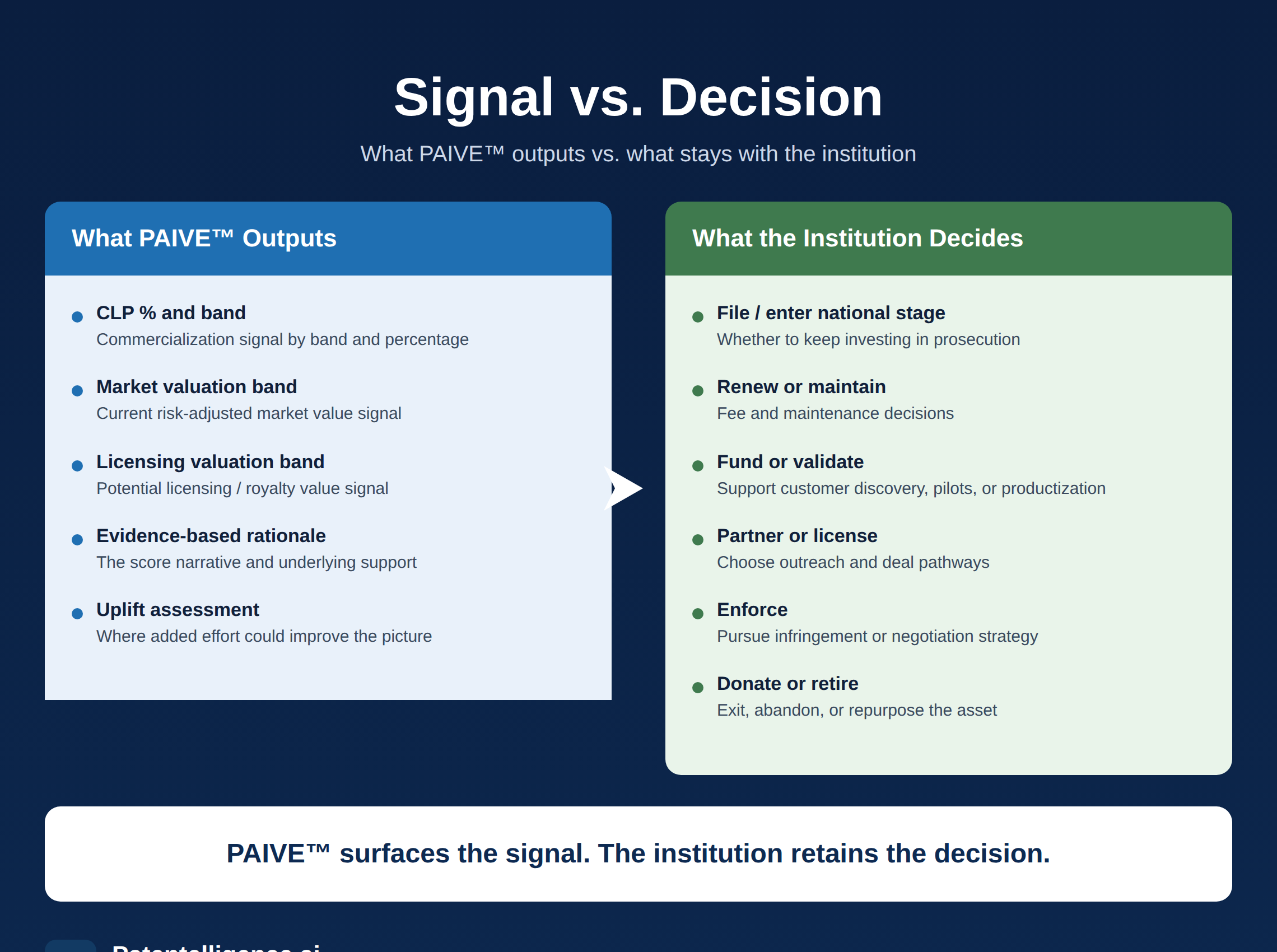
The system may generate a CLP percentage and band, a market valuation band, a licensing royalty valuation band, an evidence-based narrative, and an assessment of potential uplift opportunities.
The institution determines whether to file, renew, fund, license, partner, enforce, donate, or retire the asset.
This separation is not a limitation. It is a governance feature.
It preserves expert oversight while reducing inconsistency, unsupported intuition, and undocumented decision-making.
PAIVE™ surfaces commercialization and valuation signals. The institution retains authority over filing, funding, licensing, enforcement, donation, renewal, and retirement decisions.
The takeaway: The go/no-go line belongs to the institution
A CLP band does not establish a universal dividing line between “go” and “no-go.” It shows the strength of the current commercialization signal and gives the institution a consistent body of evidence for determining where its own line should sit.
That line will differ among institutions and portfolios. A Band 3 asset may warrant additional validation at one institution because of its mission, strategic importance, or access to development resources, while a similarly scored asset may not justify further investment elsewhere. Likewise, a low CLP score is not an automatic no-go, and a high score is not an automatic commitment to proceed.
What CLP contributes is disciplined context. It helps decision-makers understand why an asset received its score, what evidence is missing, whether meaningful uplift opportunities exist, and whether committing additional time, funding, or institutional resources is justified.
PAIVE™ brings that discipline to portfolio scale by applying the same evidence-based framework across inventions and patents while preserving expert oversight. The value is not merely that the resulting decision can be defended later. It is that the institution can establish and apply a more informed, consistent, and defensible go/no-go line today.
PAIVE™ responsibly provides the signal, evidence, and rationale. The institution determines where the line sits and what happens next.
Contact us
If you would like to learn more about our responsible, agentic AI built for patent valuation and IP commercialization strategy development, contact us at support@patentelligence.ai.